Monitoring Indoor Air Quality
Smart Building

Monitoring Indoor Air Quality

An IoT solution for real-time indoor air quality monitoring, supporting ventilation, HVAC performance, and room comfort through IAQ sensors, gateways, cloud platforms, web, and mobile access.

Consult Now
Overview

Solution Overview

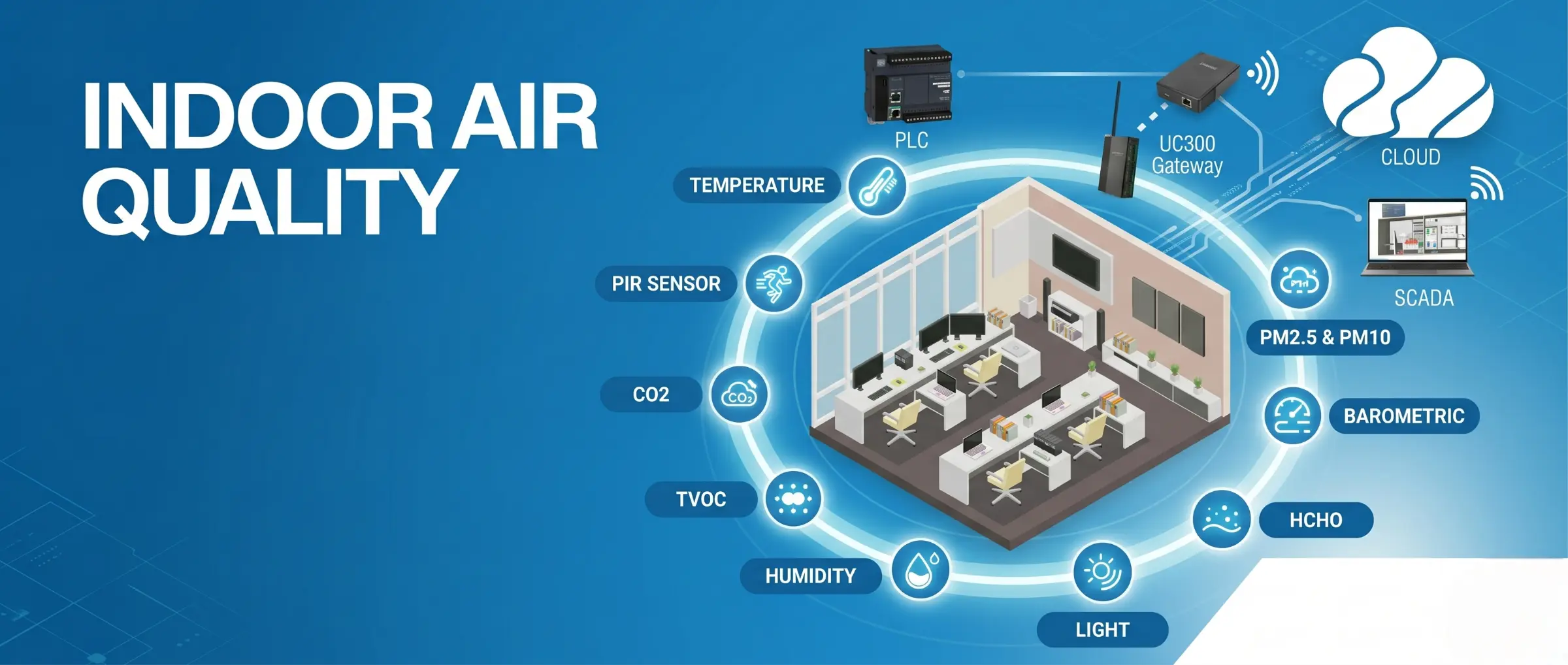
Monitoring Indoor Air Quality uses IAQ sensors and IoT controllers to measure indoor air parameters such as CO2, PM2.5, PM10, TVOC, humidity, temperature, light, barometric pressure, and HCHO.

The solution supports Demand Controlled Ventilation (DCV), where air quality data helps monitor and adjust HVAC system performance and indoor air quality management strategies. Device data can be sent to gateways, cloud platforms, SCADA, web dashboards, and mobile applications for monitoring and further integration.
Monitoring Indoor Air Quality
Challenges

Challenges We Solve

Indoor air quality is difficult to monitor consistently without integrated sensors.

Ventilation and HVAC systems often operate without real-time air quality data.

Building operators need IAQ data to support Demand Controlled Ventilation.

Air parameters such as CO2, PM2.5, PM10, humidity, temperature, TVOC, and HCHO need to be monitored from one system.

Integrating air quality data with web, mobile, cloud, SCADA, or external systems often requires additional development.

Key Features

Key Features

IAQ Sensor Monitoring

Monitors indoor air quality parameters including CO2, PM2.5, PM10, TVOC, HCHO, temperature, humidity, light, and barometric pressure.

Demand Controlled Ventilation Support

Supports DCV implementation with air quality data that can be used to monitor and adjust HVAC performance.

Web and Mobile Monitoring

Air quality data can be monitored through web and mobile platforms for easier room condition supervision.

Cloud and SCADA Integration

Supports integration with cloud platforms, SCADA, RESTful APIs, webhooks, and other external systems.

LoRaWAN and IoT Gateway Connectivity

Devices can be paired with the UG56 LoRaWAN Gateway and EG628 IoT Gateway for connectivity and data transmission.

Multi-Year Battery Operation

Sensors support long-term operation with battery life of multiple years, depending on the device type.

Benefits

Operational Benefits

Helps improve occupant comfort and indoor health conditions.

Supports HVAC optimization based on actual air quality conditions.

Enables real-time indoor air quality monitoring through web and mobile platforms.

Supports integration with cloud, SCADA, RESTful APIs, and webhooks.

Reduces cabling needs through LoRaWAN connectivity.

Supports long-term operation with multi-year battery-powered sensors.

Helps system integrators accelerate indoor air quality IoT projects.

Use Cases

  • Office buildings
  • Meeting rooms
  • Schools and campuses
  • Hospitals and clinics
  • Hotels and hospitality areas
  • Malls and indoor public facilities
  • Smart buildings
  • Indoor workspaces with HVAC monitoring requirements

Capabilities

  • Real-time indoor air quality monitoring
  • HVAC and ventilation performance support
  • Cloud, SCADA, web, and mobile data access
  • RESTful API and webhook integration
  • Long battery life sensor deployment

Details

Measured Parameters
CO2, PM2.5, PM10, TVOC, HCHO, Temperature, Humidity, Light, Barometric Pressure, PIR
Connectivity
LoRaWAN Gateway, IoT Gateway, Cloud, SCADA, Web, Mobile
Platform Integration
RESTful API, Webhook, Centralized Application Management
Recommended Gateway
UG56 LoRaWAN Gateway, EG628 IoT Gateway
Sensor Options
AM102 2-in-1 Sensor, AM103 3-in-1 Sensor, AM319L 9-in-1 Sensor
How It Works

Workflow

01

IAQ sensors measure indoor air parameters such as CO2, PM2.5, PM10, temperature, humidity, TVOC, light, barometric pressure, and HCHO.

02

Sensor data is transmitted through a LoRaWAN gateway or IoT gateway.

03

The gateway forwards data to cloud platforms, SCADA, web dashboards, or mobile applications.

04

The platform displays centralized, real-time monitoring data.

05

The data can be used for integrations, automation, webhooks, RESTful APIs, and HVAC or ventilation optimization.

Discuss your Monitoring Indoor Air Quality requirements

Kamiko's team is ready to help define an implementation design that fits your site conditions and operational goals.

Consult Now